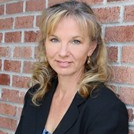
LIsa Black
Cape Coral, FL
Female, 49


I spent the five happiest years of my life in a morgue. As a forensic scientist in the Cleveland coroner’s office I analyzed gunshot residue on hands and clothing, hairs, fibers, paint, glass, DNA, blood and many other forms of trace evidence, as well as crime scenes. Now I'm a certified latent print examiner and CSI for a police department in Florida. I also write a series of forensic suspense novels, turning the day job into fiction. My books have been translated into six languages.
I'm not a DNA expert, but I know that half the 23 chromosomes in a person''s nuclear DNA come from one parent and half from the other parent, so part of the father's DNA would have to be present in the child.
Mitochondrial DNA (which is a different substance entirely, a circular structure present in the cell's mitochondria, whereas nuclear DNA is a double helix present in the cell nucleus) is passed from mother to child without recombining, so only the mother's mitochondrial DNA is present in the child. We test for mitochondrial DNA when nuclear DNA isn't available, like when we only have cut hair or fingernails or old bone to work with.
Share Answer: 

I'm afraid I don't know enough about how 3-D printing works to be able to answer. I can guess that it might be handy for reconstructing items such as shoeprints and tire tracks from photos or scans. Other than that I don't see where making a copy of something would necessarily affect a crime. And as far as I know they haven't reached the point of replicating on a cellular level such as DNA.
Share Answer: 
I'm sorry, I really couldn't. You need to ask a pathologist. Best of luck!!
Share Answer: 
No. Depending on where you work and what you do, your employer might want you to be 'certified' in one area or the other.
Share Answer: 
Fashion Model
 What's the most lucrative type of gig models can book?
Hotel Employee
 Can you give guests room upgrades at your sole discretion?
Aircraft Mechanic
 Did you ever catch something critical right before a plane was about to take off?
Why does this sound like a homework question?
Share Answer: 
It's concerning because juries expect more than is reasonable. Not every case is going to have DNA evidence and you don't always find fingerprints on a surface and eyewitness testimony sounds convincing but can be very unreliable. However an expert can hopefully explain all these issues to make the limitations clear, provided the jury listens.
Share Answer: 
You can't go wrong with a lot of science classes. When I was in college they didn't have courses specifically in forensic science, so that wasn't an option. And different agencies will have different requirements, so you might want to go online and check out the different vacancies to get some idea of what requirements are out there. You can also call labs you're interested in and ask, that way you get to 'meet' some people too.
Share Answer: 
-OR-
 Login with Facebook
 (max 20 characters - letters, numbers, and underscores only. Note that your username is private, and you have the option to choose an alias when asking questions or hosting a Q&A.)
(A valid e-mail address is required. Your e-mail will not be shared with anyone.)
(min 5 characters)
By checking this box, you acknowledge that you have read and agree to Jobstr.com’s Terms and Privacy Policy.
-OR-
Register with Facebook(Don't worry: you'll be able to choose an alias when asking questions or hosting a Q&A.)



 Browse Jobs
 Host a Q&A
 Search

 Submit Your Question
 Host a Q&A
 Last 7

