
LIsa Black
Cape Coral, FL
Female, 49


I spent the five happiest years of my life in a morgue. As a forensic scientist in the Cleveland coroner’s office I analyzed gunshot residue on hands and clothing, hairs, fibers, paint, glass, DNA, blood and many other forms of trace evidence, as well as crime scenes. Now I'm a certified latent print examiner and CSI for a police department in Florida. I also write a series of forensic suspense novels, turning the day job into fiction. My books have been translated into six languages.
How long it takes to get DNA results depends entirely on where you are sending them and how backed up they are. Our state lab used to take at least 6 months, but things have improved and now it is only a few months. However if we have a homicide that really needs quicker answers, sometimes they can do that. If the police department or state attorney's office are willing to pay (probably at least a grand. sometimes per sample) the samples can be sent to a private lab that can get results in as little as three days. It's expensive, but it also has to be a lab that is accredited and that the agencies trust. You can't assume anything from a long wait other than that the lab is backed up. They might have an overwhelming amount of cases, they might not have enough manpower, or they might not be efficiently run. It's impossible to guess.
Share Answer: 

As far as I know, it doesn't. As long as YOU weren't convicted of a felony.
Share Answer: 
That's actually two different issues. Moving a body can be determined by lividity--the blood pools at the lowest points of the body and becomes fixed, so if the lividity is not consistent with the position of the body, you can tell it was moved. I believe a pathologist would be able to see the signs that a body had been frozen (provided of course it hasn't completely decomposed by the time it's discovered) but I couldn't tell you what they are.
Share Answer: 
That depends on where you want to work and what kind of work you want to do. If you want to be a DNA analyst, take biology and biochemistry and don't worry so much about general forensics. If you want to work crime scenes, then you might want a forensic sciences program. The best way to know is to call places you might want to work at--say your dream jobs, even if they're in another state--and ask them what they require and what they look for. That's the only way to know for sure.
Share Answer: 
SWAT Team Commander (Retired)
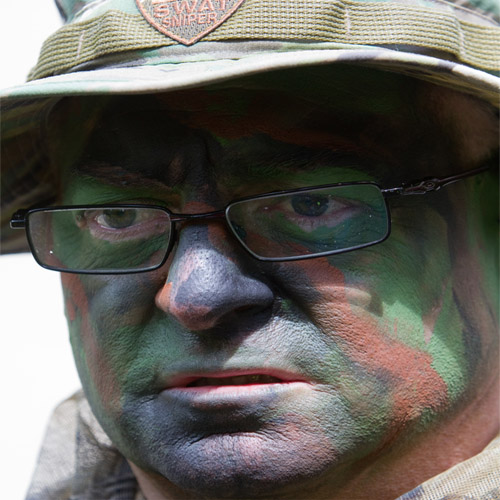 How much protection do those bomb disposal suits really provide?
Stand-Up Comedian
 How do you fend off hecklers?
Emergency Room Manager
 What's the best time to arrive at an ER to avoid waits?
That's hard to say because I only know what goes on at my particular agency, and cases are solved in all different ways--by fingerprints, by pawning stolen goods, by eyewitness testimony, through the criminal's use of electronic devices. I think more cases are solved today because there have been advances in all areas, because the world has gotten a little smaller and because the general public is more aware of criminal activity.
Share Answer: 
School project?
All our jobs vary wildly, so what's easy and hard for me might be completely different for, say, a toxicologist or medicolegal death investigator. For me I would say the easiest is working with fingerprints in the office. It's tedious and time consuming, but not hard. The hardest part is testifying in court, which is inconvenient, nerve-wracking and often insulting on a number of levels.
Share Answer: 
As I said above, patience, attention to detail, a tolerance for the more tedious parts of the job, and an affinity for science. A strong stomach helps but I knew guys who were homicide detectives for twenty years and still got queasy at the smell of a dead body, so don't let that stop you.
Share Answer: 
-OR-
 Login with Facebook
 (max 20 characters - letters, numbers, and underscores only. Note that your username is private, and you have the option to choose an alias when asking questions or hosting a Q&A.)
(A valid e-mail address is required. Your e-mail will not be shared with anyone.)
(min 5 characters)
By checking this box, you acknowledge that you have read and agree to Jobstr.com’s Terms and Privacy Policy.
-OR-
Register with Facebook(Don't worry: you'll be able to choose an alias when asking questions or hosting a Q&A.)



 Browse Jobs
 Host a Q&A
 Search

 Submit Your Question
 Host a Q&A
 Last 7

